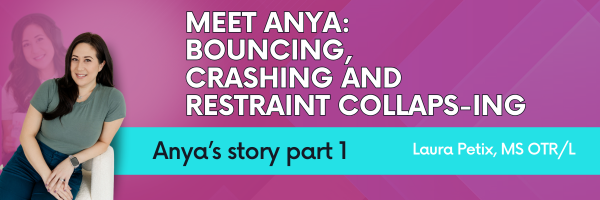
If you took a glimpse into Anya’s day—whether she was at school on the playground or at home in her living room—there was a 99.9999% chance you’d see her jumping, stomping her feet, or crashing. She loved and often sought out these big actions, even if it became a safety hazard or her peers and sister asked her to stop. Anya also loved pretend play, reading, Disney princesses, drawing, and coloring.
Her parents had been doing everything right and still felt like they were in over their heads. They knew that her behaviors were calling for more heavy work, but she seemed to be resistant to any heavy work they suggested. They knew that she needed some quiet, reset time after school, but she was usually too dysregulated to settle down. They were very knowledgeable about social-emotional skills and were in tune with her needs in that sense, though they often felt unequipped when the emotions just exploded.
Anya’s parents listed the following areas of focus for our work together:
-
Help with transitions at all three major parts of the day (morning, coming home from school, getting ready for bed)
-
Restraint collapse after school
-
How to find safer options for heavy work that Anya will actually do
-
Help for parents to maintain a sense of calm while trying to support her through her dysregulation
She had already done 1:1 OT for almost a year before being discharged, but her parents still felt like there were so many areas at home and school that needed to be addressed.
My Initial Thoughts
It’s very clear that Anya has a high threshold for proprioceptive input, and she took an active approach to regulating (which we know by her gravitation toward jumping, bouncing and crashing activities), but I also wanted to know more information about her sensory profile that might lead us to understanding more about her after-school restraint collapse.
For example, I wondered what her behavior is like in the classroom.
- Does she require constant redirection to stay seated?
- Is she constantly tapping her feet?
- Does she need reminders for personal space?
These are behaviors I guessed might be happening based on what her parents told me.
I also wanted to dig a little deeper with her parents to find out more about their home routine so I could help them come up with a sensory plan that works with their schedule.
Stay Tuned
In the next 3 newsletters, we’ll learn more about Anya’s behavior at home and school to help us craft an effective support plan for her parents and her. We’ll talk about:
-
What her teachers are seeing at school and compare them to what her parents are seeing at home. What do you think? Do you think she’s a high masker, or do you think she’s consistent across both environments?
-
What her daily routine at home looks like and how her dysregulation affects parts of the day.
-
How to get Anya’s buy-in so she can take an active role in her sensory regulation plan at home
Come back next week to find out more!
Welcome back to the Sensory Code Newsletter and thank you for your patience while I took a little hiatus.
I am back with a monthly case study, broken down into 4-5 parts each month, so you can follow along and take a step inside my brain.
While I continue the Sensory Code Newsletter, I’m also starting to record and plan for the re-release of my podcast, now set to be named The Sensory Code Podcast. It will reflect my newsletter case study formats, but this time with an interview you can watch and listen to!
If you ever wanted to work with me 1:1, this is your chance to do so-at no cost. Just fill out this form if you’re willing to share your story with my audience, and we’ll set up a time to talk!
Thanks for always being here! Let’s make 2026 the best year yet!
Disclaimer: These case studies are inspired by real-life clients I have worked with, with permission from their parents to share. Some aspects of the case are authentic, and other details are added to include more variability for our discussions. None of the strategies and advice here substitutes medical advice, diagnosis or intervention with an Occupational Therapist.

Continue learning from me:

Responses