*This post contains affiliate links*
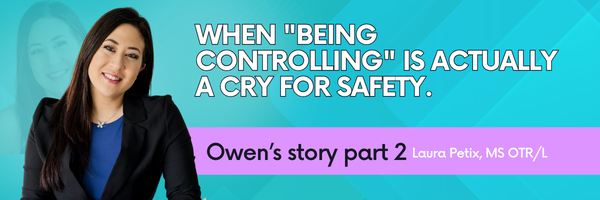
Welcome back to Owen's story. If you're just joining, head back to [Part 1] to meet him and his family.
Today we're talking about the thing that took up the most airtime in my early calls with Owen's parents: his need to control his environment.
Here's what that looked like in real life:
- He wanted the laundry machine to make certain sounds at certain volumes
- He wanted certain songs to play, in a certain order, and would spiral if the next song wasn't right
- He'd melt down at the sound of the baby's mobile, or the phone ringing unexpectedly
- Sometimes his mom's shirt color would set him off
- He'd ask his parents to repeat a sound he liked, over and over and over
Do you see the pattern here?
All of the aspects Owen needed to control were the sensory aspects of the environment. From the outside, people saw him as a kid who's being demanding, picky, or rigid. His parents were beginning to feel like they're walking on eggshells, or like they're raising a micro manager who runs the household.
Think about your car, particularly in your driver’s seat area. When you get in the driver’s seat, you have to adjust the seat position, the air vents, and the mirrors to fit your exact preferences. You might have your favorite radio stations set or prefer to drive in silence. It’s a long standing rule in our marriage that if you’re driving, you get to control the radio and air vents because the driver’s comfort takes priority. If I got into my friend’s car to drive, I would have to spend some time adjusting all the settings to my liking.
Am I being difficult? Controlling? Needy? No. I’m getting myself comfortable so I can be comfortable enough to focus on a very important task that requires a lot of regulation and executive functioning skills.
So here's what you need to take away: When a kid like Owen demands this level of control in their environment, their nervous system is usually reaching for safety, and control happens to be the fastest route there. When they can control the minute details of their environment, they’re intentionally trying to be comfortable, so they can use kind words, learn new skills, play nicely with their baby sibling, and try new food at the table.
What Sensory Sensitivity Actually Feels Like
When a kid has a highly tuned auditory system, their brain is taking in sound the way a microphone with no filter would. Every creak, every hum, every ring, every voice, all coming in at roughly the same volume.
Now add to that the fact that Owen seemed to have something close to perfect pitch. His brain was registering specific tones, pitches, and patterns with a level of detail most of us don't experience.
So when he demanded a sound repeat in a certain way, his nervous system was basically saying, "I need to make this just right and predictable so I can feel okay." It's almost like when you're trying to fall asleep and the faucet is dripping. You can't tune it out. You have to fix it or you'll lose your mind.
Owen's nervous system was in that state constantly.

{now that I think about it, Owen reminds me SO much of how Charlie Puth explains his auditory sensitivities, check it out on this reel)